Crumbling Colonial Infrastructure in India
By Alison Bouchard ‘23
Recently across the South Asian country of India, several bridges built during the British crown rule have collapsed, bringing ongoing infrastructure investments and safety practices into question.
On October 30th, tragedy befell the town of Morbi the western Indian state of Gujarat. A 754-foot suspension footbridge collapsed, just days after being reopened, following a six-month renovation period. Packed with an estimated 400 sightseers celebrating Diwali, the festival of lights, the 143-year-old colonial-era suspension bridge collapsed at around 6:30 am, plunging into the river below. The bridge, known locally as Julto Pul (swinging bridge), was a popular tourist attraction situated over the algae-lined Machchhu river in Morbi and was built to connect Darbargadh, the official residence of the former Royal family of Morbi, to Nazarbagh, another royal residence. As of October 31st, there are at least 134 dead and dozens injured. Those who survived clung to the bridge’s dangling remains and swam to shore in the darkness after falling into the river.
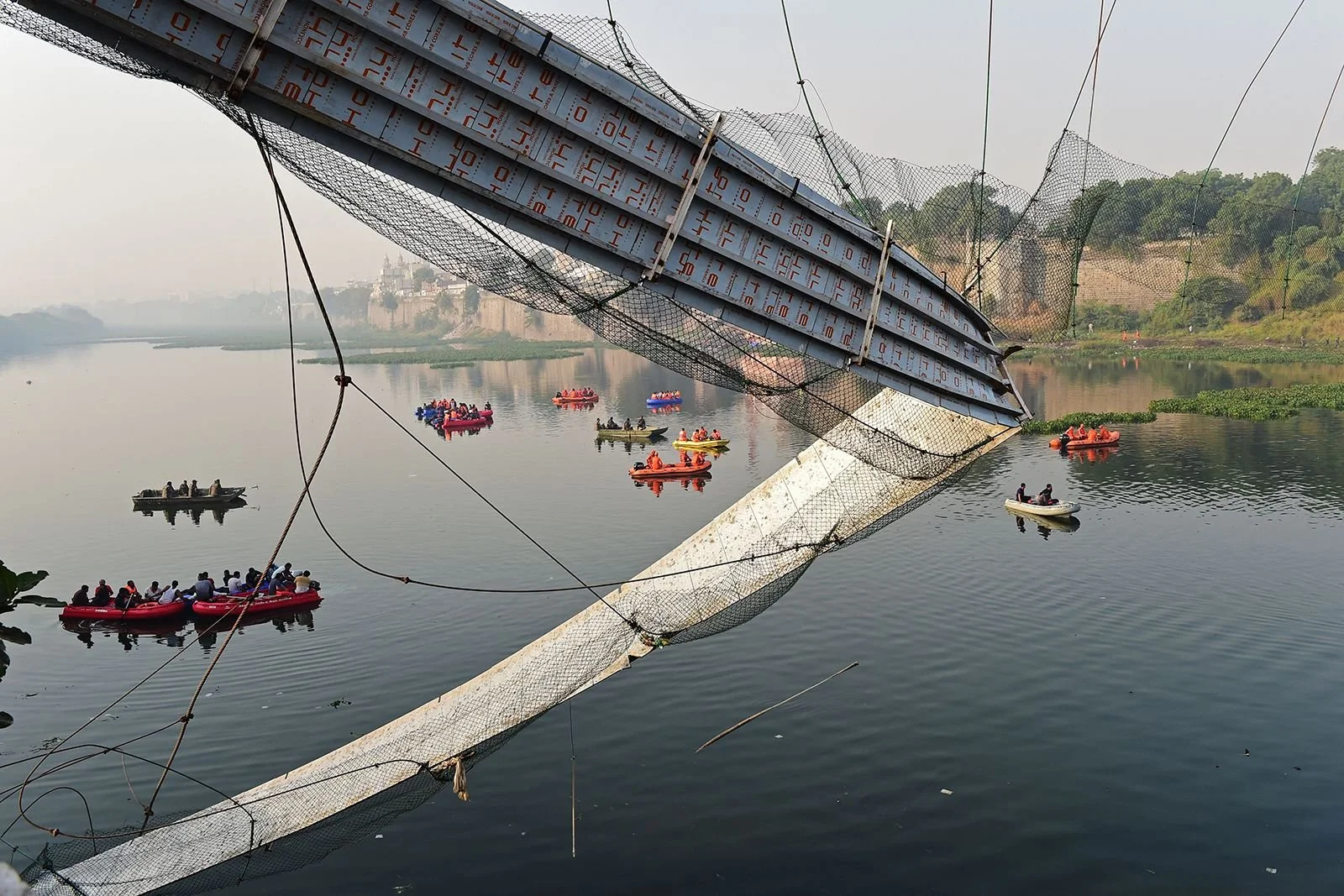
The collapsed footbridge in the town of Morbi
This isn’t the first time India has witnessed such a shocking accident. On March 14th, 2019, in the city of Mumbai, a portion of a footbridge inside a railway station collapsed and fell into the road, killing 6 and injuring at least 30. In a similar manner to the Gujarat collapse, the bridge had recently undergone a structural audit and minor repairs. It was declared “fit for use” six months earlier. However, this bridge was comparatively newer, only being 40 years old.
In 2018, there were two major bridge collapses, claiming a total of 21 lives. The first occurred in the city of Varanasi, where a portion of an under-construction flyover collapsed after the two beams holding it up buckled from intense traffic vibrations and wind force. The concrete slab crushed a minibus, four cars, and 10 two-wheelers. It claimed 18 lives. The second occurred in Kolkata, where the Majerhat Bridge collapsed onto the road below it, killing 3 and injuring 25. The bridge was over 50 years old and concerns about its stability had been brought up from 2010 up until just 2 months before the deadly collapse. Police, commuters, and local community members reported huge craters and cracks appearing along the structure of the bridge. The bridge had been under construction six months before the accident, but work was soon stopped due to financial problems.
In 2016, there were also two major bridge collapses with one occurring in the previously mentioned Kolkata. In Kolkata, a steel span of the then under-construction Vivekananda Road overpass collapsed onto pedestrians and vehicles, killing 27 and injuring 80. The overpass started construction in 2009 and was scheduled to be completed in 2010. However, workers? overshot the deadline multiple times, which led to an 18-month finish deadline to finish it by February 2016 but only about 60% of the work was completed by that point. Just hours before the collapse, workers heard a cracking noise, but company engineers told them to start work anyway.
The second accident of 2016 was in New Delhi, where a British colonial era bridge connecting the city of Mumbai to the state of Goa collapsed, sending vehicles into the flooded Savitri River, killing an estimated 40 people. The bridge was set to be demolished later in the year.
At the center of all these tragedies in India are its aging infrastructure, corruption within government departments, and a historical inability to complete projects in a timely fashion. However, India hopes to tackle these issues by committing to spend $1.4 trillion on infrastructure in the next 5 to 10 years. Even though India's government is increasing its spending for infrastructure, the government's heavy debt burden could derail its ambitions. The country may need funds from private sector investments, which will be hard to obtain since India still poses significant fraud and corruption risks to foreign investors. In a 2017 Transparency International survey, nearly 7 in 10 individuals in India admitted to paying a bribe in order to access public services, the highest bribery rate in Asia-Pacific. This data shows the extent to which corruption plagues virtually every form of government interaction. hile Prime Minister Narendra Modi has significantly reduced corruption at the Federal level, many Indian States and local governments remain at high risk.
More Resources
https://www.cbsnews.com/news/india-bridge-collapse-deaths-arrests-rescuers-recount-diwali-disaster/
https://timesofindia.indiatimes.com/city/kolkata/kolkata-bridge-collapse-pwd-ignored-multiple-red-flags/articleshow/65679150.cms https://www.thehindu.com/news/cities/kolkata/workers-heard-cracking-noise/article8423585.ece